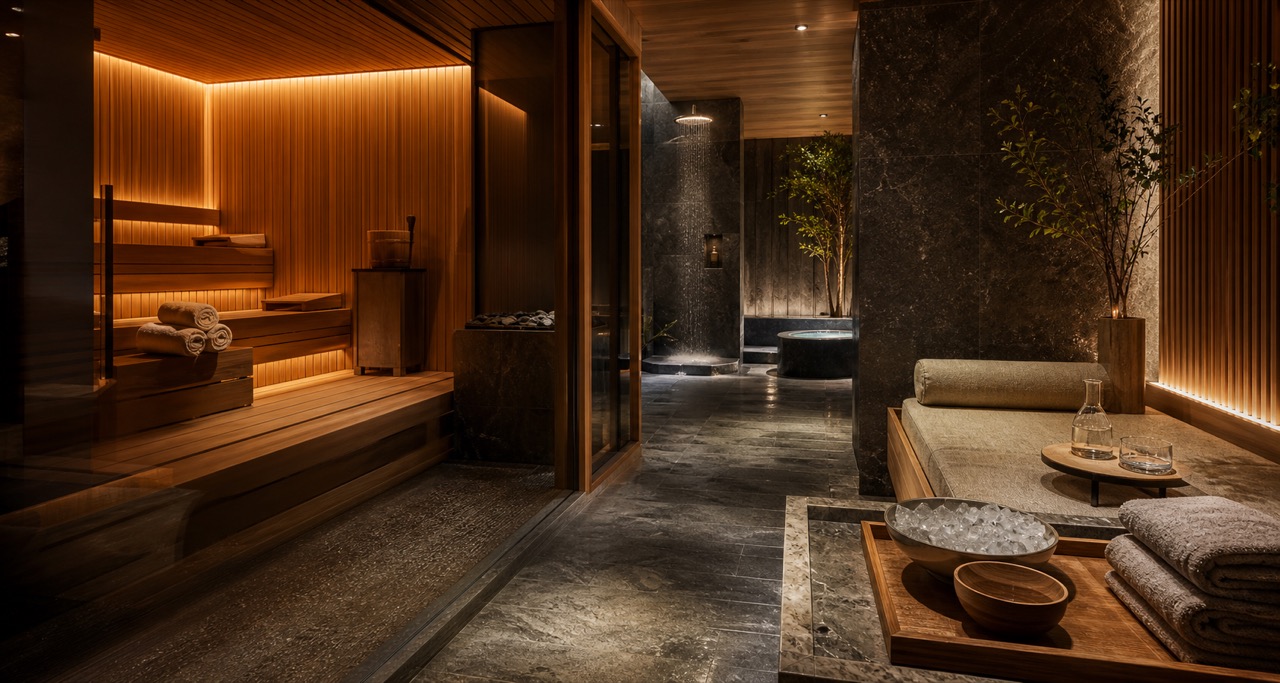
Saunas have been part of wellness hospitality for years, but many properties still treat them as amenities rather than products. That leaves money on the table. The stronger opportunity is to turn sauna use into a structured recovery ritual with clear timing, guest guidance, and premium positioning.
A 2026 review in Genetics on heat hormesis in Caenorhabditis elegans adds useful context. The paper does not validate a specific human sauna protocol, but it reinforces a broader idea that mild heat stress can trigger adaptive responses and that regimen details matter. For hospitality, that is enough to support a more disciplined, science-inspired product model.
Why this matters now
The review describes heat hormesis as a dose-dependent response in which mild heat stress can produce beneficial effects such as increased stress resilience, while higher or poorly controlled exposure can become harmful. It also emphasizes the importance of variables like temperature, duration, recovery period, and timing.
That framework is commercially useful for spas, recovery clubs, and wellness hotels because it shifts the conversation from “we have a sauna” to “we offer a guided recovery ritual.”
Guests increasingly respond to experiences that feel:
- intentional;
- premium;
- easy to understand;
- safer than self-directed use.
This is where many properties can differentiate without major new equipment.
What a hospitality sauna protocol can look like
A sauna recovery protocol does not need to look clinical. It needs to look clear.
That can include:
- defined session lengths;
- suggested rest or cooling windows;
- hydration guidance;
- sequencing with breathwork, body treatment, stretching, or recovery drinks;
- a staff-led or self-guided format depending on the property.
The goal is not to claim that one heat session changes biology in a dramatic way. The goal is to create a repeatable ritual that improves guest confidence, supports upsell, and makes the sauna experience easier to buy as a premium offer.
How to apply this in a hotel or spa
Operators should treat heat-based recovery as a product experiment. A good first step is to offer two or three curated ritual formats rather than one generic sauna access point.
Examples include:
- a short reset protocol for busy guests;
- a longer evening recovery ritual;
- a contrast-based experience paired with cooldown and hydration;
- a post-workout heat sequence in a wellness club or hotel gym environment.
Each version should have clear timing, safe use instructions, and a service wrapper that fits the property’s brand. That wrapper is often what creates premium value.
Where the revenue logic sits
Most properties already have some thermal infrastructure. The upside comes from converting passive access into an experience that can support:
- premium scheduling or private booking;
- recovery beverage sales;
- bundled body treatments;
- memberships;
- repeat-use rituals for loyal guests;
- room package upgrades.
This is especially attractive because the operational complexity can remain moderate if the protocol is simple and reproducible.
The limits and risks
This is where discipline matters. The 2026 review is based on C. elegans and discusses translational relevance cautiously. It should not be used to justify medical promises about longevity, detoxification, or guaranteed health improvement in hotel guests.
Operators also need to manage practical risks:
- overheating;
- dehydration;
- contraindications for certain guests;
- poor supervision;
- overly aggressive marketing language.
The safer positioning is science-inspired recovery, not evidence-proven treatment.
What operators should do next
If your property already has a sauna, the best next step is to make it more structured, not more complicated.
- Build two or three ritual formats with clear timing and instructions.
- Train staff on safety language and contraindication awareness.
- Add hydration, rest, and recovery touchpoints that improve perceived value.
- Test pricing as a ritual or bundle, not as generic access.
- Measure repeat use, add-on spend, and guest satisfaction.
This approach can turn an under-monetized amenity into a stronger recovery product without forcing the property into medical territory.
Conclusion
The heat hormesis conversation is useful for hospitality not because it proves a sauna protocol, but because it supports better product thinking. The properties that win with heat-based recovery will be the ones that package it as a clear, safe, premium ritual rather than a vague promise of wellness benefits.
Sauna access is easy to offer. A well-designed recovery ritual is what creates real differentiation.
FAQ
Does research on heat hormesis prove a hotel sauna improves longevity?
No. The cited review is preclinical and should not be used to make direct human longevity claims.
What is the best way to monetize a sauna in hospitality?
Package it as a guided ritual with timing, recovery, hydration, and optional add-ons rather than offering it only as passive access.
Is this only relevant for luxury resorts?
No. Urban recovery clubs, premium business hotels, spas, and wellness resorts can all use this model if they have the right infrastructure and operating discipline.
What matters most in a sauna protocol?
Clarity, safety, repeatability, and positioning. Those factors shape guest trust and commercial value more than novelty alone.
Sources
- PubMed / Genetics, “Molecular insights into diverse heat hormesis regimens in Caenorhabditis elegans,” March 4, 2026: https://pubmed.ncbi.nlm.nih.gov/41677572/
- Oxford Academic, article abstract and related overview: https://academic.oup.com/genetics/article/232/3/iyag019/8475352